1. Business Problem Introduction
As organizations grow, people operations start consuming more time than expected. HR teams spend hours updating employee records, correcting payroll discrepancies, and responding to routine questions. Finance teams double-check salary data before every pay cycle. Managers wait for reports that arrive late or require manual reconciliation.
Errors become more frequent under pressure. A missed update affects payroll accuracy. A delayed approval disrupts payment schedules. Compliance adds further strain. Labor laws change, reporting deadlines stay fixed, and audit readiness requires constant attention. Manual coordination across teams creates gaps that only appear when something breaks.
Scaling multiplies these challenges. What worked for a small workforce struggles to support a larger, more complex organization. Leadership begins to question whether current processes still support business goals or quietly hold them back.
2. What This Topic Means for Businesses
HR software refers to structured systems that manage employee information, payroll processing, compliance tracking, and reporting within a single operational framework. Some platforms focus on payroll accuracy and statutory needs. Others support the full employee lifecycle from onboarding to exit.
These systems connect HR, finance, operations, and compliance teams. Payroll accuracy depends on consistent employee data. Compliance depends on rule tracking and audit logs. Reporting supports budgeting, forecasting, and oversight.
Businesses assess operational impact to understand how daily work changes after adoption. This includes time saved, error reduction, visibility improvement, and coordination across teams. Not every organization needs advanced systems immediately. Small teams with stable headcount may operate manually for a period. Companies with growth plans, regulatory exposure, or distributed teams face higher operational risk without structured support.
Understanding impact helps leaders make informed timing and scope decisions.
3. Core Explanation: How These Systems Work in Practice
Employee Data Handling
Manual processes store employee information across spreadsheets, emails, and shared folders. Updates rely on individual follow-through. Version conflicts appear when multiple teams access the same data.
HR software centralizes employee records. Personal details, job roles, compensation, tax status, and policy acknowledgments exist in one system. Role-based permissions control access to sensitive information.
Operational impact appears through consistency. A role change updates payroll calculations and reporting automatically. HR teams spend less time validating data across sources.
Payroll Processing
Manual payroll depends on attendance records, formulas, and manual checks. Errors increase during salary changes, bonuses, or new hires. Corrections often extend into future cycles.
Software-based payroll uses predefined rules for earnings, deductions, and statutory requirements. The system applies calculations consistently. Teams review outputs before approval rather than rebuilding calculations each month.
Operational impact shows through predictability. Payroll cycles stabilize. Finance teams trust outputs sooner. Fewer last-minute corrections disrupt schedules.
Compliance Tracking
Manual compliance relies on calendars, reminders, and individual awareness. Rule changes may go unnoticed. Audit preparation requires gathering documents from multiple sources.
HR systems track compliance obligations inside the platform. Audit trails log salary updates, tax changes, and approvals. Reports generate directly from system data.
Operational impact appears as reduced disruption. Compliance work becomes part of routine operations instead of a periodic scramble.
Reporting and Audits
Manual reporting requires consolidation across files. HR and finance teams reconcile discrepancies before sharing insights. Audit requests interrupt normal workflows.
Software systems provide standardized reports for payroll, compliance, and workforce analysis. Data exports integrate with accounting systems. Audit readiness improves through traceable records.
Operational impact reflects in faster decision support and fewer reporting delays.
4. Comparison Table: Manual Processes vs HR Software
| Area | Manual HR Processes | HR Software Systems |
|---|---|---|
| Employee data | Disconnected files | Centralized records |
| Payroll processing | Repetitive calculations | Rule-based automation |
| Compliance tracking | Manual reminders | Built-in tracking and logs |
| Operational impact | High admin workload | Streamlined workflows |
| Cost implications | Hidden labor expense | Predictable operating cost |
| Risk exposure | Dependency on individuals | Lower risk through controls |
5. Business Evaluation Checklist
✔ Central employee records management
✔ Payroll automation with approval controls
✔ Compliance tracking and audit logs
✔ Reporting for finance and audits
✔ Integration with accounting systems
✔ Support for workforce growth
This checklist helps teams assess whether operational improvements justify adoption effort.
6. Pricing and Cost Structure Explanation
Operational impact assessment includes cost structure understanding.
Per Employee Per Month
Most HR software follows a per employee pricing model. Costs rise with headcount. This aligns expense with usage but requires forecasting during growth phases.
Add-On Modules
Core HR may exclude payroll, compliance, or advanced analytics. Each module increases recurring cost. Operational impact improves as features expand, yet budget pressure grows.
Implementation and Onboarding Costs
One-time fees cover data migration, configuration, and training. Complexity increases cost. Multi-location payroll or regulatory requirements require additional setup effort.
Ongoing Support and Management
Premium support, customization, or dedicated account management often increase cost. Internal administrative effort remains part of total ownership.
Prices vary based on geography, compliance scope, integration needs, and service levels. Public pricing rarely reflects full operational cost.
7. Risks, Limitations, or Trade-Offs
HR software adoption introduces trade-offs.
Setup complexity affects short-term operations. Poor configuration leads to incorrect outputs. Skilled internal ownership remains necessary.
Ongoing management continues. Policy updates, tax changes, and employee lifecycle events require attention.
Cost creep occurs when teams add modules or expand usage without reassessment. Long-term budgets must account for growth.
Some platforms limit flexibility. Businesses may adjust workflows to fit system design. Customization improves fit yet increases maintenance effort.
Balanced planning helps avoid replacing one set of challenges with another.
8. Common Mistakes Businesses Make
-
Assessing tools before mapping operational workflows
-
Ignoring compliance needs during evaluation
-
Overestimating immediate productivity gains
-
Underestimating onboarding effort
-
Assigning no internal system owner
-
Evaluating cost without considering time savings
Each mistake distorts impact assessment and delays value realization.
9. Graphs or Insight Visuals Explained
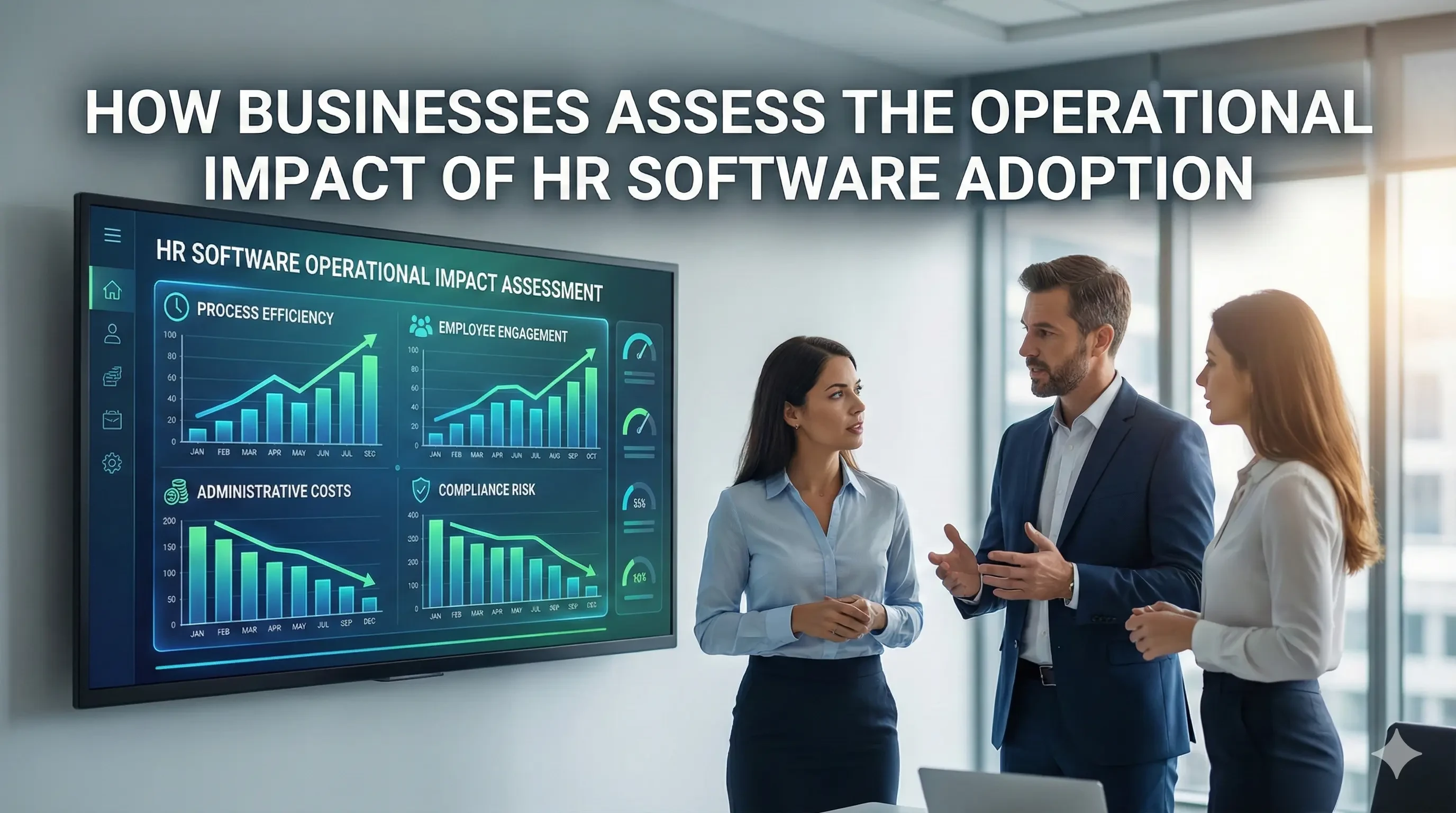
One useful graph plots administrative time spent on HR tasks against employee count. Manual processes show steep growth as headcount increases. Software-based processes grow more gradually.
Another chart compares payroll error frequency before and after adoption. Manual systems show variability during changes. Software-based systems stabilize once configured.
These visuals help leaders assess operational predictability rather than cost alone.
10. Practical Summary
Businesses assess the operational impact of HR software by examining daily workflow changes, not just feature lists. Manual processes consume increasing time, introduce errors, and strain compliance as organizations scale.
HR software improves consistency through centralized data, rule-based payroll, and audit-ready reporting. Costs include subscriptions, setup effort, and ongoing management. Benefits appear through reduced admin work, improved accuracy, and better visibility.
Decision-makers gain clarity by aligning adoption scope with growth plans, compliance exposure, and internal capacity. A measured evaluation supports operational stability without unnecessary complexity.