1. Business Problem Introduction
Many businesses start with informal HR processes. Employee records live in spreadsheets. Payroll runs rely on formulas copied from previous months. Compliance reminders sit on calendars or email threads. This approach feels manageable during early stages.
Problems surface as teams grow. HR staff spend increasing time updating records and checking data consistency. Payroll errors appear more often due to manual calculations and last-minute changes. Employees raise concerns about incorrect pay or missing benefits. Each correction consumes more time than the original task.
Compliance pressure increases in parallel. Labor laws evolve. Tax rules differ by location. Filing deadlines remain strict. Manual tracking leaves room for missed updates or late submissions. Even without penalties, leadership time shifts from growth planning to issue resolution.
Scaling exposes the core issue. Manual HR processes do not scale linearly. Risk and workload grow faster than headcount.
2. What This Topic Means for Businesses
Manual HR processes refer to people operations managed through spreadsheets, emails, shared folders, and disconnected tools. These methods depend heavily on individual effort and institutional memory.
Software-based HR systems centralize employee data, payroll calculations, compliance tracking, and reporting in a controlled environment. Some platforms focus on payroll and statutory requirements. Others manage the full employee lifecycle.
These systems sit at the intersection of HR, finance, and operations. Payroll accuracy relies on consistent data. Compliance depends on rule tracking and auditability. Reporting supports financial planning and oversight.
Businesses with stable headcount and limited regulatory exposure may operate manually for a time. Companies with frequent hiring, distributed teams, or compliance obligations face higher risk without structured systems.
Understanding the trade-off helps decision-makers choose timing and scope rather than reacting after failures occur.
3. Core Explanation: How These Systems Work in Practice
Employee Data Handling
Manual systems store employee information across files and folders. Updates depend on human follow-through. Version control issues appear when multiple people edit records.
Software-based systems maintain a single employee record. Personal details, compensation, tax status, and policy acknowledgments live in one place. Role-based access controls protect sensitive information.
Data consistency improves. A role change updates payroll, reporting, and access rights automatically. This reduces mismatch across departments.
Payroll Processing
Manual payroll relies on formulas, attendance sheets, and manual checks. Errors increase during hiring cycles, salary revisions, or bonus periods. Corrections often carry into future pay runs.
Software systems use rule-based payroll engines. Pay structures, deductions, and statutory rules apply consistently. Teams review outputs before approval rather than recalculating from scratch.
Automation lowers repetitive effort while preserving oversight.
Compliance Tracking
Manual compliance tracking depends on calendars, emails, and individual awareness. Rule changes may go unnoticed. Audit preparation requires pulling records from multiple sources.
Software systems track compliance requirements within the platform. Audit trails log changes to salaries, tax details, and approvals. Reports generate directly from system data.
Compliance becomes part of daily operations rather than a periodic scramble.
Reporting and Audits
Manual reporting requires data consolidation. HR and finance teams reconcile numbers across files. Audit requests disrupt normal operations.
Software systems provide standardized reports for payroll, compliance, and workforce analysis. Data exports integrate with accounting tools. Audit readiness improves through traceable records.
Reporting accuracy depends on proper setup and disciplined use.
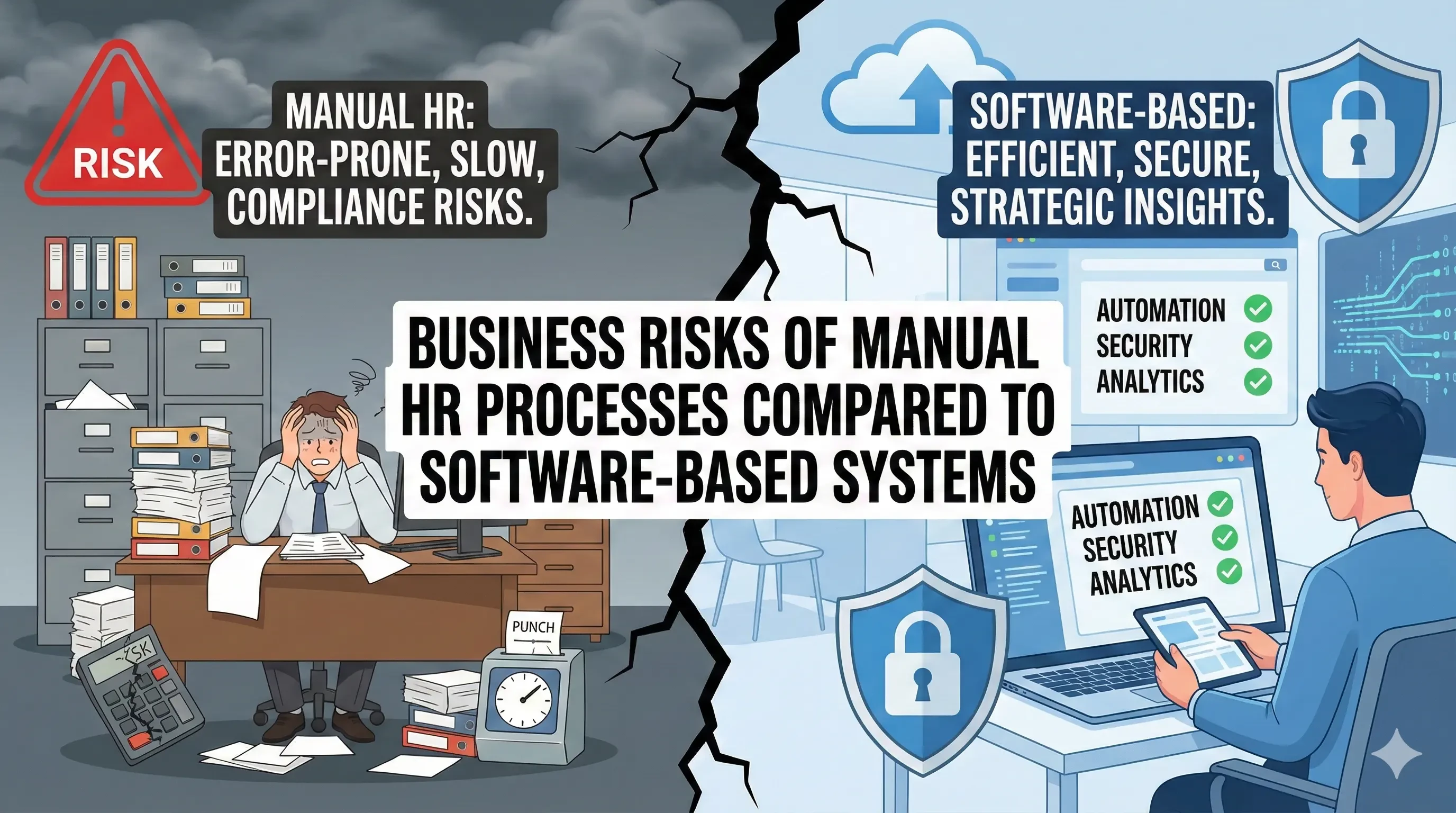
4. Comparison Table: Manual HR vs Software-Based Systems
| Area | Manual HR Processes | Software-Based Systems |
|---|---|---|
| Employee data | Scattered files and spreadsheets | Centralized structured records |
| Payroll accuracy | High error risk | Rule-based calculations |
| Compliance tracking | Manual reminders | Built-in tracking and logs |
| Operational impact | High admin workload | Reduced repetitive tasks |
| Cost implications | Hidden labor cost | Predictable operating expense |
| Risk exposure | High dependency on individuals | Lower risk through controls |
5. Business Evaluation Checklist
✔ Central employee records
✔ Payroll automation with review controls
✔ Compliance tracking and audit logs
✔ Reporting for finance and audits
✔ Integration with accounting systems
✔ Support for workforce growth
This checklist helps businesses assess readiness and identify gaps before choosing a system.
6. Pricing and Cost Structure Explanation
Software-based HR systems follow several pricing patterns.
Per Employee Per Month
Most vendors charge based on active employee count. Costs scale with growth. This model aligns usage with expense but requires planning during hiring phases.
Add-On Modules
Core HR features may include payroll or compliance as separate modules. Advanced reporting, benefits management, or performance tools often increase cost.
Implementation and Onboarding Costs
One-time setup fees cover data migration, configuration, and training. Complexity increases with multi-location payroll or regulatory scope.
Support and Maintenance
Premium support, customization, or dedicated account management may sit behind higher plans. Internal admin effort also forms part of total cost.
Pricing varies based on geography, compliance complexity, integration needs, and vendor service levels. Public pricing rarely reflects full ownership cost.
7. Risks, Limitations, or Trade-Offs
Software adoption introduces its own considerations.
Setup requires planning. Poor configuration leads to incorrect payroll outcomes. Skilled internal ownership remains essential.
Ongoing management continues. Tax changes, policy updates, and employee events require regular attention.
Cost creep can occur. Add-ons, user expansion, and support upgrades raise long-term spend.
Some systems limit flexibility. Businesses may adjust workflows to match platform design. Customization solves this issue but adds maintenance overhead.
Balanced evaluation prevents replacing one set of risks with another.
8. Common Mistakes Businesses Make
-
Delaying structured systems until errors escalate
-
Selecting software without mapping internal workflows
-
Ignoring jurisdiction-specific compliance needs
-
Overbuying advanced features early
-
Assigning no internal system owner
-
Treating subscription fees as total cost
Each mistake increases operational friction or long-term expense.
9. Graphs or Insight Visuals Explained
One useful graph plots HR error frequency against employee count. Manual processes show rising error rates as headcount grows. Software-based systems stabilize after configuration.
Another chart compares administrative time spent on payroll. Manual systems rise sharply during hiring and policy changes. Software systems show flatter growth due to automation.
These visuals highlight risk predictability rather than cost alone.
10. Practical Summary
Manual HR processes carry growing business risk as organizations scale. Payroll errors, compliance gaps, and reporting delays consume time and erode trust. These risks often remain hidden until a failure occurs.
Software-based systems reduce dependency on individual effort through centralized data, rule-based processing, and auditability. They introduce costs and setup effort yet offer more predictable operations.
Decision-makers benefit from assessing risk exposure, growth plans, and compliance scope before transitioning. A measured approach aligns system capability with real operational needs and supports stable business growth.